Wax On, Stream Off: The Glorious, Space-Devouring Madness of Choosing Vinyl Over Spotify
Let's be honest about something: Spotify works. It's right there on your phone. It knows what you want before you do. It has essentially every song ever recorded by every human who ever lived, available instantly, for roughly the cost of a single cup of coffee per week. By any rational measure, it is an objectively superior music delivery system.
And yet.
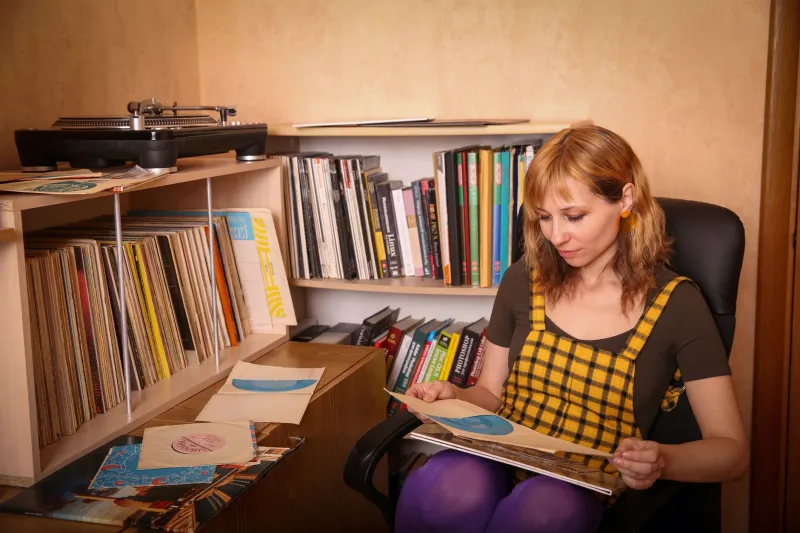
And yet, there are people — millions of them, many of whom own perfectly functional smartphones — who are instead hauling crates of 12-inch vinyl records home from flea markets, carefully sliding them into poly sleeves, alphabetizing them by artist, sub-alphabetizing by release year, and then lying awake at 2 a.m. wondering if they need a second room.
This is the vinyl revival. It's been going on for a while now, it shows no signs of slowing down, and if you haven't yet lost a friendship group member to the wax rabbit hole, give it another six months.
The Numbers Don't Lie (Even If They Do Confuse Everyone)
Here's the part that still makes industry analysts do a double-take: vinyl records have outsold digital download albums for several consecutive years running. Not streaming — that's still king, obviously — but the format that requires a physical needle, a spinning platter, and ideally a room warm enough that your stylus doesn't warp, is beating digital downloads in raw sales. In 2023, the Recording Industry Association of America reported that vinyl generated over $1.2 billion in revenue, continuing a streak that would have seemed like a fever dream back in the Napster era.
The people buying all those records? Overwhelmingly millennials and Gen Xers — the exact demographic that grew up ripping CDs to iTunes and treating MP3 files like precious digital cargo. The generation that invented the digital music era is now enthusiastically retreating from it, one $35 repress at a time.
So Why, Though?
Ask a vinyl collector why they prefer records to streaming and prepare for an answer that takes between four and forty-five minutes depending on how much coffee they've had.
Mark, a 38-year-old graphic designer from Portland, Oregon, has been collecting for about six years and currently owns somewhere in the neighborhood of 800 records — though he's stopped counting with any precision because, as he puts it, "the number started making my wife nervous."
"It's not even really about the sound, though I do think it sounds better," he says, seated in what used to be a home office and is now essentially a record library with a desk crammed into one corner. "It's about the ritual. You pick an album. You take it out. You look at the artwork. You flip it over. You actually sit down and listen to it. When's the last time you sat down and listened to an album on Spotify without also scrolling Instagram?"
This is the argument you'll hear most consistently from vinyl devotees: it's not just a format preference, it's a behavioral one. Streaming is built for distraction. The infinite queue, the algorithm-generated recommendations, the seamless shuffle — it's all designed to keep audio playing in the background of your life. Vinyl, by its physical nature, demands the opposite. You get roughly 20 minutes per side, then the record ends and you have to get up and do something about it. It's inconvenient in a way that turns out to be kind of wonderful.
Sandra, a 44-year-old teacher from Chicago who started collecting during the pandemic, describes it as "forced mindfulness, but make it cool." Her collection — currently at around 300 records and climbing — lives in the living room in a setup that her teenage kids have grudgingly admitted is "actually pretty aesthetic."
"I have Spotify. I'm not a lunatic," she clarifies. "I use it in the car. But when I get home and I want to actually listen to music, I put on a record. It changes the whole energy of the room. It's intentional."
The Storage Problem Nobody Warned You About
Here is the part of the vinyl revival conversation that the music press tends to gloss over in favor of more romantic narratives about warmth and analog soul: records take up an absolutely insane amount of physical space.
A single IKEA Kallax unit — the unofficial official shelving solution of the global vinyl community — holds roughly 200 to 250 records. It's about 57 inches wide and 57 inches tall. Most serious collectors own multiple Kallax units. Some own many, many more.
Mark, our Portland collector, currently has four Kallax units, two standalone shelving systems, and what he describes as "a situation in the closet" that he's not ready to talk about publicly.
"I've done the math," he says, with the expression of a man who has done math he deeply regrets. "If I keep buying at my current rate, I will need to either convert the garage or have a very specific conversation with my wife. Possibly both."
There are entire Reddit communities — r/vinyl being the obvious mothership, with over 1.5 million members — dedicated not just to record recommendations and turntable setups, but to the increasingly creative problem of where to put all the records. Basement conversions. Built-in shelving. Elaborate garage storage systems. One user famously documented a full room renovation undertaken specifically to accommodate a collection that had grown to over 3,000 albums. The comments were 40% impressed, 40% deeply concerned, and 20% asking for the contractor's number.
The Ritual Is the Point
What the streaming services will never fully replicate — and what every collector eventually lands on when you push them hard enough on the why — is the ceremony of it. The specific gravity of holding a record you love, reading liner notes written before the internet existed, dropping the needle and hearing that split second of crackle before the music starts.
It's the same instinct that's driving the cassette comeback, the disposable camera resurgence, and the inexplicable return of physical planners. In a world where everything is immediate, frictionless, and algorithmically optimized, there's a deep human hunger for things that require just a little bit of effort. Things that are yours in a way that a Spotify playlist never quite is.
You can't lose your vinyl collection when a licensing deal expires. You can't have it removed from your library because a label pulled it from the platform. You can't accidentally shuffle it into a workout playlist. It just sits there, in its sleeve, waiting for you to be intentional enough to play it.
That's worth a second Kallax unit. Probably.
Maybe a third.
Don't tell your spouse.