Ring Ring, I Quit: The Radical Weirdos Swapping Their iPhones for Rotary Phones and Loving Every Second of It
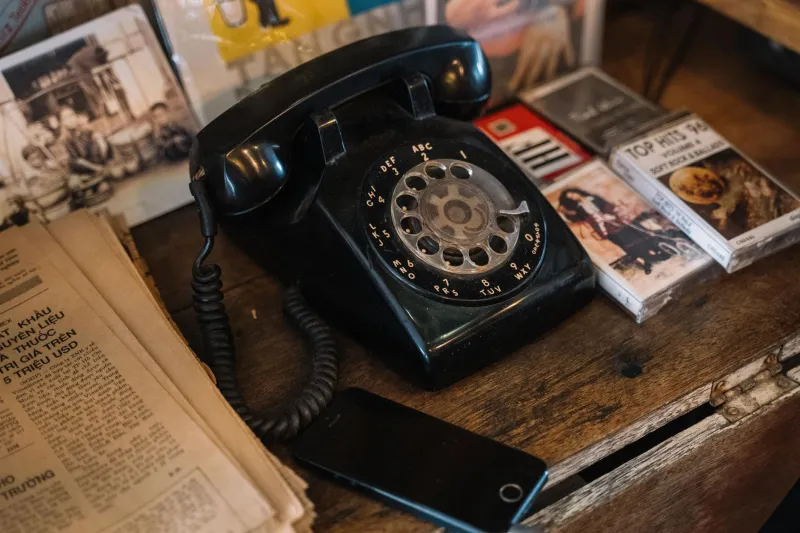
Somewhere in Portland, Oregon, a 38-year-old graphic designer named Marcus is sitting next to a 1965 Western Electric rotary phone, waiting for it to ring. He is not anxious. He is not refreshing anything. He does not have seventeen browser tabs open. He is, by his own description, "genuinely at peace for the first time since 2009."
Marcus gave up his smartphone eight months ago. Not for a flip phone, not for a dumb phone, not even for one of those $400 Light Phone minimalist gadgets that tech bros buy to feel superior at dinner parties. No — Marcus went full rotary. Corded. Pulse-dialing. The whole theatrical production.
"The first week I thought I was going to lose my mind," he admits, laughing. "By week three, I realized I hadn't lost my mind. I'd actually found it."
Marcus is not alone, and he is not a quirky outlier in a think-piece about one guy doing something weird. He is part of a quietly expanding movement of digitally exhausted Americans who are deliberately choosing the most friction-heavy communication technology imaginable — and reporting back that it has changed their lives in ways no wellness app ever could.
The Seductive Inconvenience of Dialing
Here's the thing about a rotary phone that nobody tells you: it forces you to commit. Dialing a number on a rotary phone takes about eight to twelve seconds per digit if you're doing it right, which means calling a ten-digit number is a genuine fifteen-to-twenty-second physical undertaking. You have to mean it. You have to want to talk to that person.
Compare that to the average smartphone interaction, where you can fire off a half-formed thought to 200 people in the time it takes to blink. The rotary phone is, in a very literal sense, a gatekeeper. A bouncer for your attention.
Dr. Patricia Nguyen, a clinical psychologist based in Chicago who specializes in digital burnout, says the appeal makes complete psychological sense. "What we're seeing is people craving intentionality," she explains. "The smartphone has eliminated every natural pause between impulse and action. The rotary phone reintroduces friction, and friction, counterintuitively, is often what makes an experience feel meaningful."
She's careful to note this isn't a clinical treatment she prescribes — but she's had multiple clients describe similar experiments on their own, with notably positive results. "One patient told me that calling her mother on a rotary phone felt like sending a letter," Nguyen says. "Like it mattered more because it cost something."
The Unexpected Social Fallout
Of course, there's a catch. Several catches, actually, and they are deeply, almost comedically inconvenient.
Being unreachable by text is, in 2024 America, basically a personality disorder as far as most people are concerned. Rotary phone adopters report a universal experience: the first month is socially catastrophic. Friends think you're ignoring them. Coworkers assume you've had a breakdown. Your mom leaves seventeen voicemails in four days because she can't send you a meme about cats.
Tanya, a 41-year-old nurse from Nashville who made the switch six months ago, describes the social renegotiation as "genuinely exhausting but also kind of clarifying." She kept her smartphone for work obligations but retired it at home, replacing it with a powder-blue Princess phone from 1972 that she found at an estate sale for $22.
"I had to have actual conversations with people about how to reach me," she says. "Which sounds insane, but it turned out to be incredibly useful. I found out real fast who was willing to make the effort and who wasn't."
The results, she says, were not entirely comfortable. "Some friendships kind of... dissolved. But the ones that didn't got so much better. People actually call me now. Like, voice calls. And they're long. And they're good."
The Hardware: A Collector's Paradise
For the retro-inclined, there's an obvious secondary appeal here that goes beyond the philosophical: the phones themselves are gorgeous.
Western Electric rotary models from the 1950s through the 1970s are built like small tanks. The handsets are heavy. The dials have a satisfying mechanical resistance. The bells — actual physical bells — produce a ring so authoritative that it commands a room without apology. These are objects designed in an era when "built to last" wasn't a marketing slogan but an engineering expectation.
Vintage phone collecting has been a niche hobby for decades, but adopters who are using these phones daily rather than displaying them are bringing new energy to the market. Prices on eBay and Etsy for working rotary models have crept upward over the past two years. A clean, fully functional Western Electric 500 — the iconic desk phone that lived in every American home for thirty years — now routinely sells for $40 to $120 depending on color and condition. Rare colors like harvest gold or avocado green command a premium that would have seemed absurd five years ago.
For those who want the aesthetic without the pulse-dialing commitment, touch-tone phones from the 1980s offer a middle ground — faster to dial, still deeply analog, and available in a staggering variety of novelty shapes that serve as both functional communication devices and conversation pieces.
The Actual Logistics (Yes, They're Complicated)
Let's be real: running a vintage rotary phone in 2024 requires some mild technical gymnastics. Most modern phone service runs through VoIP or fiber systems that aren't automatically compatible with the analog signals rotary phones produce. Adapters exist — specifically, analog telephone adapters (ATAs) that convert digital signals back to the analog format these old phones were designed for — and they work reliably, but you'll need to spend an afternoon on setup and probably watch a YouTube tutorial.
Also, you will need to actually memorize phone numbers. This is not optional. This is, perhaps, the single most jarring aspect of the whole experiment for people under 50. The average American cannot recall more than three phone numbers from memory in 2024. Rotary phone adopters report that memorizing even six or eight numbers feels like a strange cognitive superpower after a few weeks.
"I know my sister's number, my best friend's number, my doctor's office, and my favorite pizza place," Marcus says. "That's honestly enough. That's my whole life."
Is This Sustainable? Is It Supposed to Be?
Nobody in this movement is pretending that rotary phones are a scalable solution to the attention economy. You cannot receive a boarding pass on a rotary phone. You cannot use two-factor authentication. You cannot, critically, order a pizza at 11:45 p.m. through an app while lying on your couch in the dark.
But that might be exactly the point. For a certain flavor of digitally fried American, the rotary phone isn't a replacement for modern life — it's a deliberate counterweight to it. A room in the house where the 21st century doesn't get to come in.
The dial tone, that long steady hum before you dial, used to mean possibility. Somewhere along the way it got replaced by a notification badge. These people just want the hum back.
Honestly? We get it.