Mold, Splice, and Tears: Inside the VHS Rescue Underground
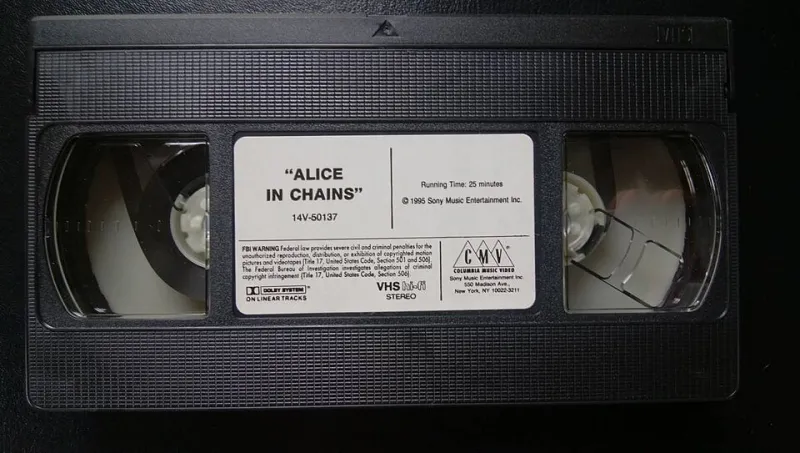
Photo: English: Label printed by Columbia Music Video, the distributor of the VHS., Public domain, via Wikimedia Commons
The Basement Smells Like 1994
The box arrives at Kevin's door in a priority mail envelope, wrapped in three layers of bubble wrap and a Ziploc bag. Inside is a VHS tape—a wedding video from 1994, recorded on a camcorder the size of a cinder block. The tape is moldy. Not a little moldy. The fuzzy white kind that looks like a science experiment. The label has faded to a pale yellow, and someone has written 'JEN & MIKE WEDDING' in blue ballpoint pen.
Kevin puts on latex gloves and a dust mask. He sets up his workspace: a VCR he bought at Goodwill for $12, a cleaning cassette, a bottle of 99% isopropyl alcohol, and a set of foam swabs. He's part of a loose underground network of VHS repair hobbyists and small-time operators who clean, splice, and digitize dead tapes. They call themselves 'tape-heads,' a name that started as an insult and became a badge of honor. They work out of basements, garages, and the back rooms of independent video stores. They do it for money sometimes—$30 to $50 a tape—but mostly they do it because they can't stand the idea of a family memory rotting away in a closet.
A Very Gross Economy
The economics of VHS rescue are precarious. The equipment is cheap but finicky. A good VCR costs $50 to $100 on the secondary market, but it's a crapshoot—you might get one that eats tapes, or one that plays them with a weird line of static across the middle. Cleaning supplies are cheap, but the labor is time-consuming. A moldy tape can take two hours to clean and digitize, and the results are not guaranteed. If the tape is too far gone, the best you can do is capture the audio and a few frames before the oxide sheds off the backing.
'There is no money in this,' says Kevin, a 41-year-old IT technician from Pennsylvania who has been rescuing tapes for six years. 'I charge $40 a tape, and I tell people upfront that I might not be able to save it. Sometimes I do it for free because the story is too sad. I'm not running a charity, but I'm also not running a business. It's a hobby that pays for itself, barely.'
The demand is real. Families find boxes of tapes when they clean out a parent's house or a childhood bedroom. Wedding videos, birthday parties, first steps, school plays—all of it recorded on a format that nobody supports anymore. The tapes have been sitting in attics and basements, where the heat and humidity have been slowly destroying them. Some of them have mold. Some have been chewed by a bad VCR. Some have sticky-shed syndrome, a condition where the binder in the tape breaks down and turns into a gooey mess. Those are the hard cases, and they're the ones that keep the tape-heads up at night.
Rituals of the Tape-Heads
Every tape-head has their own process. Kevin starts with an inspection—hold the tape up to the light, look for mold, check the reels. If it's moldy, he cleans it with a mix of isopropyl alcohol and distilled water, running the tape through a cleaning cassette or, in extreme cases, hand-cleaning the tape path with a swab. He uses a rubber eraser to gently buff the edges of the tape, which sounds like nonsense until you see it work.
Then there's the digitizing. Kevin uses a capture card and a software called VirtualDub, which hasn't been updated since the '90s but still works. He captures the video to a lossless AVI, then encodes it to MP4. The whole process takes about an hour for a clean tape. For a moldy tape, it might take three. He has a stack of tapes waiting in his garage, each with a sticky note: 'DO NOT PLAY—MOLD' or 'AUDIO ONLY' or 'WEDDING—JEN & MIKE—PRIORITY.'
The tape-heads share tips on forums that feel like they were frozen in 2004. They argue about the best cleaning solution, the best VCR model, the best way to splice a broken tape. They trade horror stories about tapes that disintegrated mid-capture or clients who expected a miracle. They also trade victories: the wedding video that was rescued from the brink, the baby's first steps that survived despite the mold, the grandmother's voice that hadn't been heard in twenty years.
Why We Can't Let Go
The VHS rescue movement is not really about nostalgia for the format. Nobody misses the tracking lines or the fuzzy picture or the fact that you had to rewind. It's about the content. Those tapes are the only record of a certain kind of life—a life before smartphones, before cloud storage, before every moment was documented and instantly shareable. A wedding video from 1994 is not just a video. It's a time capsule, and it's slowly turning to dust.
'The families who send me these tapes are not collectors,' Kevin says. 'They're not trying to be cool. They just want to see their mom's face again. They want to hear their dad's laugh. The tape is the only thing that has it.' He pauses. 'I don't always succeed. I had one last month that was so moldy I couldn't save it. I called the client and told them. She cried on the phone. I cried after I hung up.' He laughs, a little embarrassed. 'That's the job. It's not a job. It's a weird, dusty, emotional thing that we do because we can't let go.'
The underground is growing. More people are discovering the scene, driven by a mix of nostalgia, pandemic-era decluttering, and the realization that their parents aren't going to be around forever. The tape-heads are happy to have the company. They just wish people would store their tapes in a cool, dry place. That's the real lesson here: the best way to preserve a memory is to take care of it before it starts to mold. But if you didn't, there's a guy in a basement with a dust mask and a bottle of alcohol who might be able to help.