Food Court Royalty: The Grown-Up Mall Rats Taking Back the Dead Mall
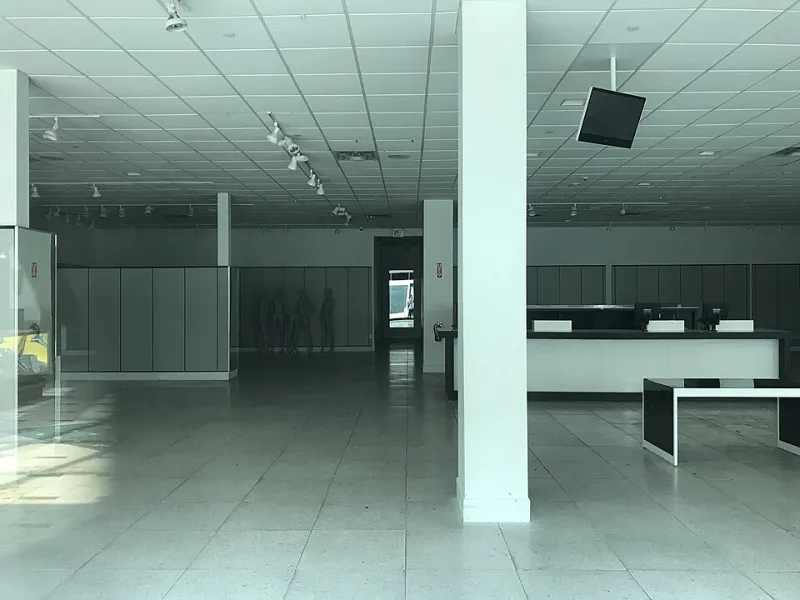
Photo: BornToZucc, CC BY-SA 4.0, via Wikimedia Commons
The Third Place Has a Cinnabon
Something strange is happening at the Westminster Mall in Southern California on a Tuesday night. The Gap is dark. The Spencer's Gifts is darker. But near the food court, a dozen adults in their late thirties and early forties are doing laps past a closed Sbarro, nodding at each other like regulars at a dive bar. No one is buying anything. That's the point.
Welcome to the grown-up mall rat revival, a loosely organized movement of Gen X and millennial nostalgia seekers who have decided that the half-dead shopping center is the perfect place to reclaim the unsupervised hangout time they lost somewhere between college and their first mortgage. Across the US—from the dying corridors of the Puget Sound to the echoing concourses of suburban Ohio—people are arranging after-hours mall walks, arcade meetups, and food-court coffee klatches in retail spaces that look like they were evacuated in a hurry. In 2026, the mall isn't a place to shop. It's a place to exist.
A Food Court Is a State of Mind
The rules are simple and completely unwritten. You show up. You walk. You maybe buy a pretzel. You do not mention work. You do not check your phone. And if you find a quarter on the floor near the coin-operated horse, you ride the horse.
'The mall was the original third place,' says Dana, a 43-year-old graphic designer from Columbus who organizes a monthly 'Mall Walk & Talk' at a nearly vacant galleria. 'It wasn't home, it wasn't school, and it wasn't work. It was neutral ground with an Orange Julius. We're just trying to get that back without the pressure of actually buying a $90 candle.'
The events are popping up everywhere. In the Pacific Northwest, a group called Dead Mall Social Club hosts Friday-night walks through a Tacoma center that still has a working carousel but no working escalators. In New Jersey, a 38-year-old named Marcus runs an arcade night in the back of a struggling mall, dragging in vintage cabinets and charging five bucks at the door. The food court provides the ambiance—fluorescent hum, sticky tables, the distant sound of a vacuum—and the mall provides the space. It's less about commerce and more about the strange comfort of being surrounded by the ghosts of commerce.
The Unwritten Rules of the After-Hours Mall Walk
Participants have developed a code. First, you don't call it a 'meetup.' It's a 'walk.' Second, you don't linger too long in front of any store—security gets nervous, and you look like you're casing the place. Third, you must patronize at least one food-court vendor per visit, even if it's just a dollar-fifty for a crappy fountain drink. This keeps the mall from kicking you out and, more importantly, keeps the lights on for one more month.
'We have a guy who brings a folding chair and just sits outside the old Waldenbooks for an hour,' Dana says. 'He calls it 'reading the air.' I don't fully understand it, but I respect it.'
There's also the matter of the arcade. If your mall still has one—and a surprising number do, clinging to life like a cockroach in a nuclear winter—the arcade is the anchor. Grown adults are dropping real quarters into Galaga and Ms. Pac-Man, not because the games are better than a PS5, but because the act of standing shoulder-to-shoulder with a stranger and yelling at a pixelated ghost is a form of social contact that doesn't require a calendar invite. 'I haven't talked to this many strangers since 1998,' one walker tells me, before returning to a high-score battle on a Track & Field cabinet.
Retail Apocalypse? More Like a Sleepover
The retail apocalypse has been documented to death. We know the stores are closing. We know the anchors are hollowed out. But what the trend pieces miss is that the emptiness itself has become an amenity. A dead mall is quiet. It's climate-controlled. It has bathrooms. And in 2026, when every third place costs $6 for a latte and plays music so loud you can't hear yourself think, a cavernous corridor with a distant Muzak loop feels like a spa.
Some mall management companies have noticed. A handful of properties in the Midwest and Sun Belt now actively court the nostalgia crowd, hosting 'retro nights' with DJs spinning '90s hits and letting local vendors set up tables in the empty storefronts. It's not altruism—it's a last-ditch attempt to get bodies through the doors. But for the mall rats, it's a win. They get their clubhouse. The mall gets foot traffic. The Auntie Anne's gets someone to buy a pretzel at 8 p.m. on a Wednesday.
What the Dead Mall Gives Back
The revival isn't really about the mall. It's about what the mall represented: a place you could go without a plan, without a reservation, without a credit card. A place where you could be bored in public, which is a skill many of us lost when our phones became entertainment centers. The grown-up mall rats are not trying to bring back the '90s economy. They're trying to bring back the '90s feeling of having nowhere to be and no one to impress.
'My kid asked me why I go to the mall if I'm not buying anything,' Dana says. 'I told her it's the same reason she goes to the park. It's just a place to be.' She pauses. 'Also, the pretzels are better than the park.'